
Human-on-the-loop
The agent explores, probes, and validates; a person owns the decisions that carry accountability. That pairing isn't a limitation on agentic pentesting, it's what makes it safe to run against real systems. Here's the model, and why the human stays in it.
What it means
Human-on-the-loop describes how work is split between an agent and a person. The agent does the breadth, exploring the attack surface, mutating parameters, replaying flows, validating what's exploitable, and a researcher makes the calls that require human accountability before execution goes further.
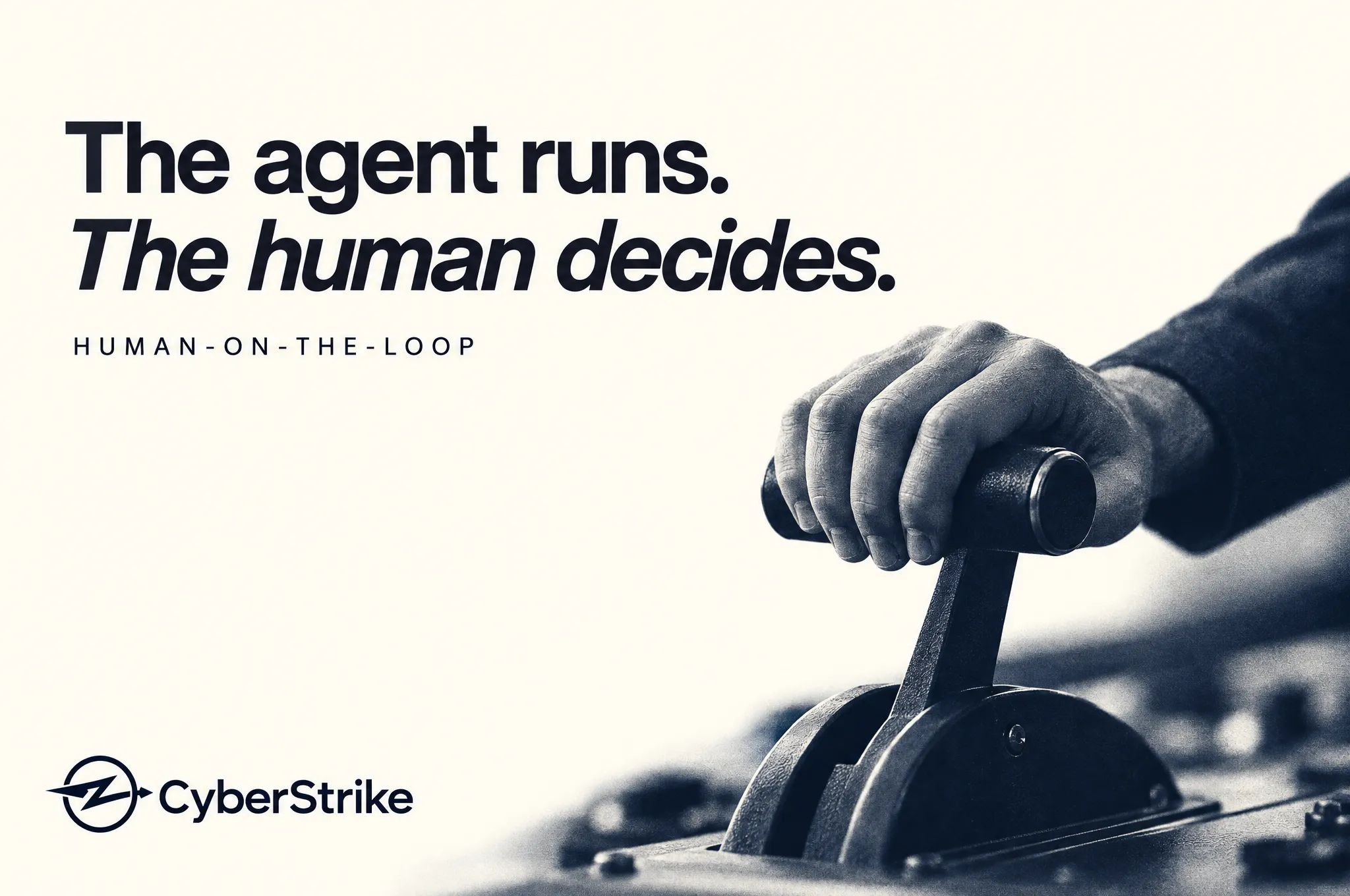
It's worth separating from two neighbors. Human-in-the-loop puts a person in the path of every step, which doesn't scale. Full autonomy removes the person entirely, which isn't safe on systems that matter. On-the-loop sits between them: the agent runs continuously, and the human is present at the decisions that need a human, not at every keystroke.
Why automation never closed the gap
For most of its history, pentesting has been defined by individual researchers. The hard findings, the IDOR buried three workflows deep, the auth bypass that only surfaces after a specific sequence of requests, the race condition that needs precise timing, come from people who reason about how an application behaves, not just what inputs it accepts.
Most tools treated automation as a force multiplier for known techniques: feed it a target, it runs its checks, it hands back a report. That's fine for surface coverage, directory brute-forcing, known-CVE checks, header analysis, and useless for the work that matters. Scanners don't reason about trust boundaries or chained behavior across workflows; they find what they're told to find. The model never changed: the researcher did all the reasoning, and the tool just executed instructions.
A different division of labor
An agent is not a scanner with better marketing. The difference that matters is that it interacts with an application the way a researcher does, exploring it, watching how it responds, and adjusting based on what it finds. It can replay authenticated flows, systematically mutate inputs, and test variations across endpoints, and when the application changes after a deploy, revisit those paths on its own.
Crucially, it can validate findings, not just flag them, and it keeps the full execution trace: which endpoints were hit, how inputs were modified, what condition made a signal surface. So the researcher's job stops being "redo the agent's work to confirm it." The evidence is already there to inspect. The researcher's job becomes the decisions, which paths are worth pursuing, and which actions are allowed to proceed.
Why the human is what makes it deployable
The case for keeping a person in the loop isn't nostalgia, it's what fully autonomous offensive security can't safely do. A tool that executes without oversight creates concrete risk: actions that exceed the rules of engagement, findings that can't be tied to a clear decision, audit trails that don't hold up where they're reviewed. On a production system, "the agent did it" is not an acceptable answer.
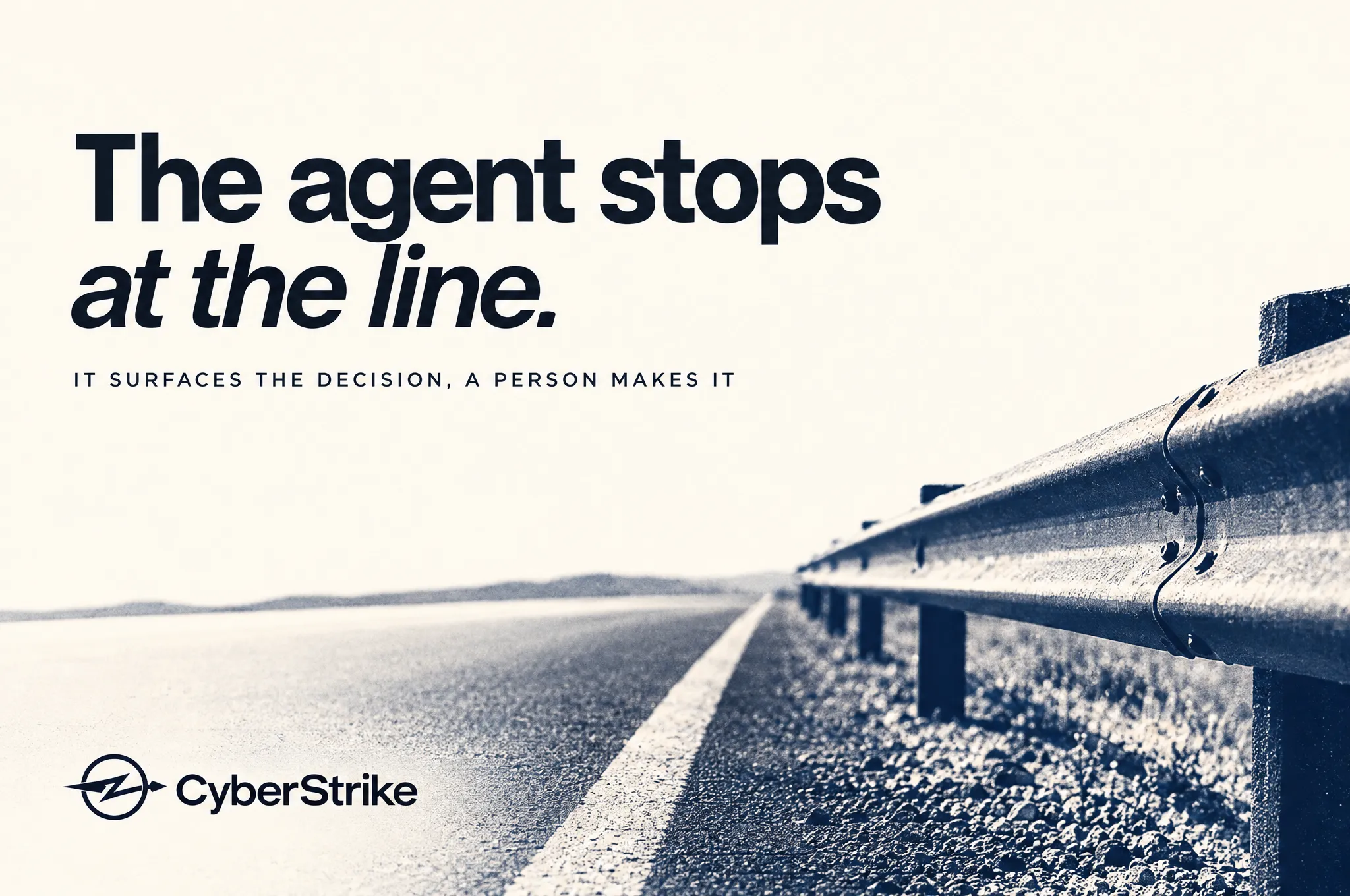
So the human-on-the-loop isn't a weakness of the model, it's the thing that lets you run it at all. When an agent reaches a guardrail, to protect stability, stay within scope, or meet a compliance requirement, it surfaces the decision to a person, and the person decides what happens next. That accountability is deliberate. It's the line between a system an organization can actually trust and one it can't.
Guardrails get sharper, not fewer
As the agents improve and the boundaries are refined through real use, the moments that need a human become fewer and more precise. That's the honest trajectory, and it's worth being careful about how it's described: the guardrails don't disappear. They get better. Fewer interruptions because the agent has learned where the real decisions are, not because the decisions stopped mattering.
There's a compounding effect, too. As a researcher directs the investigation and confirms what's meaningful, the continuous coverage starts to reflect that accumulated judgment, rather than a generic playbook run on a schedule. The human isn't reviewing output after the fact; they're shaping where the testing goes.
What it means for the researcher
The role of the pentester isn't disappearing, it's changing. Researchers become the accountability layer that sets how far the agents can go: not directing every action, but unlocking the ones that need a human decision first. Less time spent rediscovering the same surface; more spent on judgment, validation, and the calls that have to be owned by a person.
That's the whole claim, and it's a modest one. For anyone willing to work this way, it's not a loss of craft, it's a change in where the craft is spent, away from the repetitive breadth a machine handles well, toward the reasoning and accountability a machine shouldn't.
CyberStrike is an AI-augmented penetration testing platform, currently in early access. Want to see how the agents and the human fit together?Meet the agentsor join the waitlist.
Start from the beginning?