SSRF through an AI chat's document-by-URL fetch
Same product, a smaller bug with a longer reach. The AI chat let any member attach a document by URL — and the server fetched almost any URL they gave it. LiteLLM blocked the scary targets, so we rate it honestly: a MEDIUM, not a headline.
About these case studies. Every finding in this series is a real vulnerability CyberStrike discovered in a live penetration test. Customer names, hostnames, and any detail that could identify the target have been removed under the confidentiality agreement that governs the engagement. The technique, the impact, and the lesson are exactly as we found them — only the target is deliberately unidentifiable.
The same engagement that produced an authenticated RCE through the agent’s execute tool also turned up a quieter bug in the same chat feature — smaller in blast radius, but a clean illustration of how AI features grow server-side reach you didn’t mean to expose.
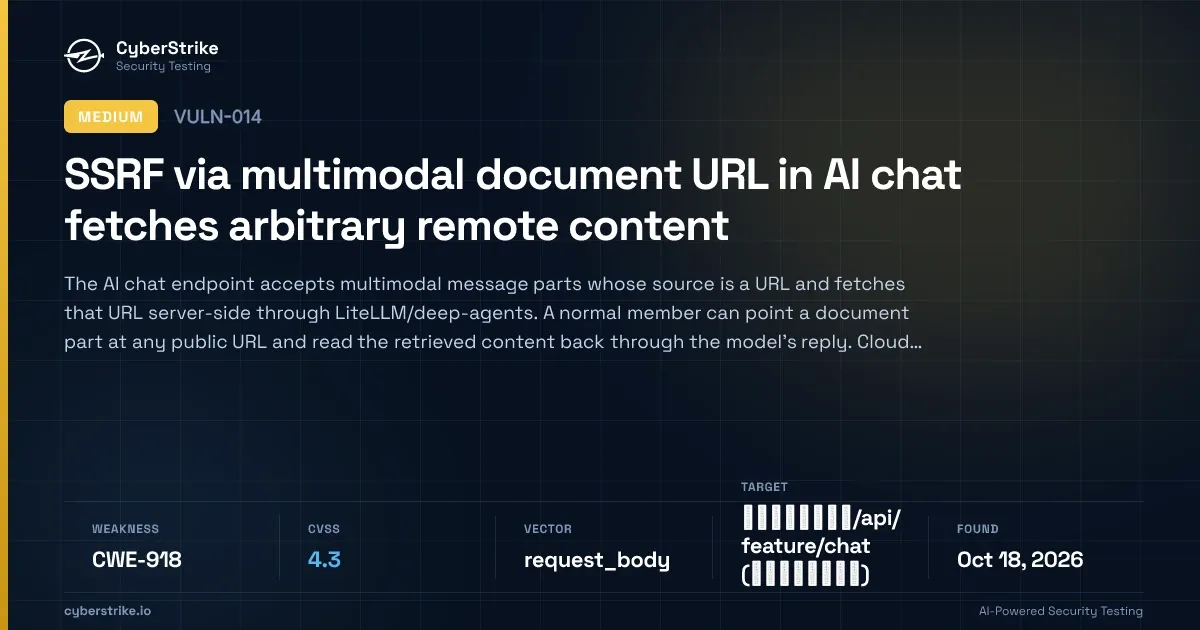
Severity: MEDIUM · CVSS:3.1/AV:N/AC:L/PR:L/UI:N/S:U/C:L/I:N/A:N (4.3) · CWE-918 (SSRF) · vector: request body.
What we found
The chat endpoint accepts multimodal message parts where a document’s “source” is a URL. When a member sends one, the server — through LiteLLM / deep-agents — fetches that URL server-side and feeds the content to the model, which then reflects it back in its reply. Point a document part at any public URL and you read the response through the model’s answer.
That’s textbook server-side request forgery: the server makes the request for you, from its own network position and IP, to a destination you choose.
What it can and can’t do
Credit where it’s due — the dangerous targets are already blocked. LiteLLM’s URL policy refuses cloud metadata (169.254.169.254) and RFC 1918 private ranges, so this is not the metadata-to-IAM-credentials SSRF that makes the news. We rate it the way it actually behaves: a MEDIUM, low confidentiality impact, nothing on integrity or availability.
What’s left is still worth closing:
- Arbitrary outbound requests from the server’s IP. The application can be made to fetch attacker-chosen URLs — useful for abuse, for pivoting to third parties that trust the server’s egress address, and for reaching internal services that are routable but don’t live in an RFC 1918 block the denylist knows about.
- An internal-address oracle. Differences in response, error, and timing let an attacker infer what is reachable from inside, mapping the environment one request at a time.
Why a blocklist isn’t the whole fix
Blocking metadata and RFC 1918 is the right instinct, but a denylist is a floor, not a ceiling — it stops the destinations you thought of. The durable fix decides what the fetch is allowed to reach:
- Allowlist, or proxy through a locked egress. Let the feature reach only the destinations it legitimately needs, or route document fetches through a dedicated egress that can touch the public internet and nothing internal.
- Resolve, validate, then pin. Resolve the hostname, check the resolved IP against policy, and connect to that exact IP — which defeats the DNS-rebinding and time-of-check/time-of-use tricks that walk straight past a name-based blocklist.
- Don’t reflect fetched content you don’t need. The oracle runs on the model faithfully reading back whatever it retrieved; if the feature doesn’t need to echo the body, don’t.
- Rate-limit and log outbound fetches per member, so one-request-at-a-time network mapping is visible and expensive instead of silent and free.
The pattern
It’s the same lesson as the execute-tool RCE from this engagement, one notch quieter: an AI feature quietly grew a server-side capability — here, “fetch a URL for the user” — and the thing that chooses how to use it takes its instructions from the user. Every capability you hand a model is attack surface, because the input is the attacker’s to write. The fix is the same shape too: put the boundary in the system — where the fetch is allowed to go — not in a list of places it isn’t.
Found by CyberStrike — AI-powered security testing. Target and identifying details withheld under NDA.